

Views: 0 Author: Site Editor Publish Time: 2026-11-18 Origin: Site


Before approving an exhibition stand build, separate destination rules and event fire-risk assessment inputs from product-level documents. Then check whether each material test report matches the actual stand component and whether its test method proves only the stated laboratory result, not full acceptance for every venue.
Start with the event or venue requirements, then collect the risk-assessment inputs, material test reports, supplier declarations, and installation or use instructions that connect the proposed stand to that destination.
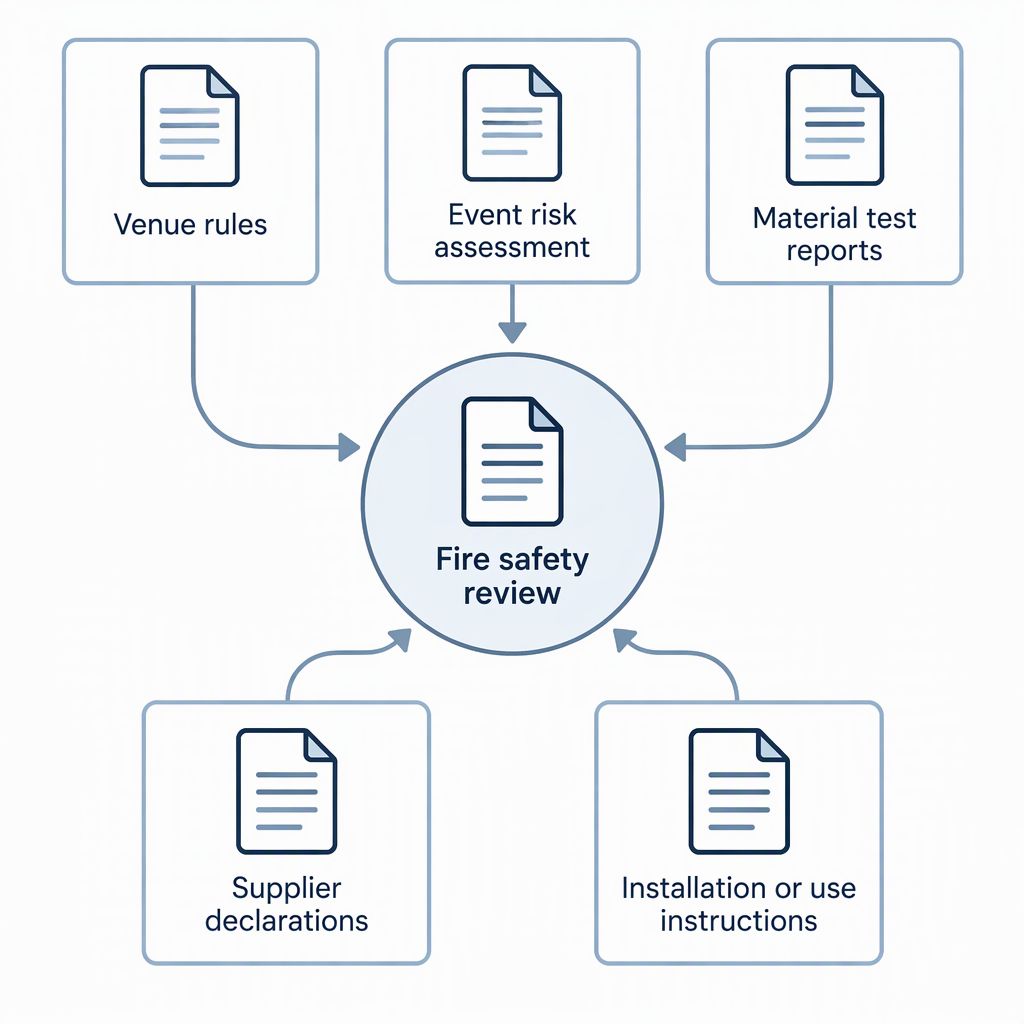
Document to request | What it helps the buyer decide | What it does not prove by itself |
|---|---|---|
Event manual, venue fire rules, and local authority instructions | Whether the proposed exhibition stand package fits the destination’s fire-safety review process and responsibility structure. | It does not prove that a specific panel, fabric, graphic, flooring, or connector has passed a fire test. |
Fire-risk assessment inputs for the stand area | Whether layout, occupancy, ignition sources, escape routes, and control measures have been considered for the event context. | It is not a substitute for material-specific test evidence. |
Material test reports for surfaces and components | Whether the named material was tested under the named method, such as surface-burning evaluation under ASTM E84. | A controlled-condition test method does not, by itself, incorporate every factor needed for real fire-hazard or fire-risk assessment. |
Supplier declaration and bill of materials | Whether the documents refer to the same stand components that will be produced, shipped, assembled, and used. | It should not be treated as an independent laboratory test unless it includes a matching test report. |
Installation, dismantling, and use instructions | Whether the stand will be assembled and used within the supplier’s stated limits and the event’s safety controls. | It does not override the venue, show organiser, or local authority requirements. |
A venue or event fire-risk assessment considers the event setting and control measures; it is not the same thing as a test report proving the fire behaviour of a named stand material.
Item | Main purpose | Buyer check |
|---|---|---|
Event fire-risk assessment | Identifies fire risks and adequate fire-safety measures for the event context. | Confirm who is responsible for providing inputs and who approves the final assessment for the venue. |
Material test report | Reports the result of a specified laboratory test for a specified material under controlled conditions. | Check the tested material name, specimen description, test method, date, laboratory identity, and result units before relying on it. |
Supplier product claim | Summarises what the supplier says about the stand, material, or configuration. | Ask for the underlying report, certificate, or manual section that supports the claim. |
Installation and use instruction | Explains how the stand should be assembled, used, loaded, cleaned, moved, and dismantled. | Check whether the planned graphics, lighting, accessories, and floor covering stay within the stated limits. |
For UK events, the Health and Safety Executive explains that organisers, employers, building owners or occupiers must carry out and maintain a fire safety risk assessment and take adequate and appropriate fire safety measures based on the findings.
For surface-burning evidence, ASTM E84 reports flame spread and smoke developed indices under controlled test conditions; it is not a complete real-world fire-risk assessment on its own.
Destination rules come first because the event organiser, venue, insurer, and local authority may require documents or controls that are more specific than a supplier’s generic statement.
Ask for the current exhibitor manual and identify the person or department that approves fire-safety submissions.
Confirm whether the destination requires a fire-risk assessment, a stand-layout review, material test reports, flame-retardant treatment records, or written method statements.
Match the planned stand type to the rules: portable display, modular aluminium frame, fabric graphic system, raised floor, enclosed room, overhead feature, lighting, or storage area.
Check whether the rules apply by country, city, venue, organiser, show type, stand size, height, enclosure, or occupancy.
When the venue names a test standard or certificate type, ask the supplier for a document that uses the same material description and the same or accepted test method.
Do not approve production only because a brochure uses words such as “fireproof,” “flame retardant,” or “compliant.” Ask for the document that supports the claim.
The HSE fire safety guidance for events is useful for understanding the UK event-risk-assessment responsibility model. Use that type of regulator guidance for the relevant jurisdiction, then confirm the adopted rules with the actual venue and show organiser.
A test report is useful only when the tested specimen, test method, and reported result match the material and configuration that will be used in the exhibition stand.
List the visible and concealed materials in the proposed stand: frame, panels, fabric graphics, printed boards, flooring, adhesives, edge trims, counters, storage elements, and decorative finishes.
For each material, ask for the matching laboratory report or accepted certificate named by the venue or authority.
Read the method name and scope. ASTM E84 is an active ASTM test method for surface burning characteristics of building materials and reports flame spread and smoke developed indices.
Check that the report does not get stretched beyond its scope: ASTM states that this method does not by itself incorporate all factors required for fire-hazard or fire-risk assessment under actual fire conditions.
Compare the tested specimen description with the ordered material, including coating, print layer, substrate, thickness, treatment, and mounting condition where those details are stated.
Ask the supplier how substitutions will be controlled. A substitute panel, textile, coating, or print process may need a different document.
If the stand uses powered lighting, screens, tools, or powered accessories during set-up or maintenance, switch off and disconnect the relevant power source before any manual access, adjustment, cleaning, or cable handling. Then follow the equipment manual and the venue’s permitted work rules.
The ASTM E84 standard page helps buyers understand that a named test method has a defined scope and limitation. Treat a report as material-specific evidence, not as a universal guarantee for the whole exhibition build.
For portable or modular stands, the supplier document pack should make it easy to trace every safety-related claim from the proposed component to the destination requirement.
Bill of materials that identifies frame, panel, fabric, graphic, floor, counter, storage, lighting, and accessory materials.
Stand drawings that show footprint, height, enclosed areas, exits, storage zones, electrical locations, and any overhead or suspended elements.
Material test reports for components where the venue requires surface-burning, flame-spread, smoke, or similar fire-performance evidence.
Supplier declarations that clearly state which materials and configurations are covered, without replacing independent test evidence where the venue requests it.
Installation, dismantling, packaging, transport, and use instructions for the exact stand system or configuration.
Change-control note for substitutions, added graphics, local print production, rented furniture, lighting changes, and late design revisions.
Event-specific forms or risk-assessment inputs requested by the organiser, venue, building owner, occupier, or employer responsible for the event.
If the document says... | Ask this follow-up question | Reason for the question |
|---|---|---|
“Flame retardant material” | Which material, treatment, test method, laboratory, and report number support that wording? | Broad wording can hide differences between fabric, print media, board, coating, and assembled stand configuration. |
“Complies with venue rules” | Which venue manual, date, show name, and approval contact is being referenced? | Venue requirements can vary by destination and event, so the rule source must be current for the actual build. |
“Tested to ASTM E84” | Does the report identify the same material and state the flame spread and smoke developed indices under that method? | ASTM E84 is a defined surface-burning test method, not a blanket acceptance decision for every stand use. |
A practical review workflow starts with the destination rule set, then checks each stand component, document, and change before production or shipment locks the buyer into the wrong package.
Collect the event manual, venue fire-safety submission requirements, and risk-assessment responsibilities for the specific destination.
Create a component register for the stand design, including portable frames, modular connectors, wall panels, printed graphics, flooring, furniture, lighting, packaging, and on-site accessories.
Map each required fire-safety document to a component, rule, or responsibility. Leave no claim floating without a document owner.
Review laboratory test reports against the named material and the test method’s scope before treating them as relevant evidence.
Check installation and use instructions against the planned build method, dismantling sequence, electrical use, cleaning method, transport packaging, and venue restrictions.
Resolve gaps before approving production, printing, shipment, or local substitution. If the venue must approve documents, submit them early enough for corrections.
Record the document title, date, issuer, material covered, stand area covered, and approving party.
Keep the approved document pack with the design file, procurement record, shipment file, and on-site build team.
Recheck the pack after any change to graphics, material, coating, supplier, floor covering, lighting, enclosed room, or destination.
The safest procurement decision is not to look for one universal “fire safe” label, but to build a document chain from destination rules to stand components and supporting reports.
Use the venue and event fire-risk process to identify responsibilities and required controls.
Use material test reports to support specific material claims, while respecting the stated limits of the test method.
For portable and modular stands, approve production only after the document pack matches the actual design, materials, substitutions, and destination.
These questions help procurement, design, and distribution teams turn fire-safety paperwork into a practical pre-build approval checklist.
Ask which destination rules apply, who approves the submission, which materials require test reports, whether every claim has supporting documents, and whether substitutions will trigger a new review.
A declaration can be useful for traceability, but it should not replace the venue-required test report, certificate, manual, or risk-assessment input when those documents are requested.
Usually the buyer should check the report against the named material and test method because ASTM E84, for example, reports surface-burning indices for building materials under controlled conditions rather than a complete real-fire assessment of a whole stand.
No. Event fire-safety responsibilities and required measures are tied to the event context, so buyers should check the current rules for the destination venue, organiser, and local authority.
Designers should check whether the new print media, coating, textile, board, adhesive, floor finish, or decorative layer changes the material covered by an existing report or requires a separate document.
Keep the approved venue submission, bill of materials, drawings, supplier declarations, material reports, installation and use instructions, and any change approvals linked to the order and destination.
Ask for local review when the stand is large, enclosed, multi-level, uses significant electrical equipment, includes unusual materials, or is going to a destination with specific venue or authority approval requirements.


