

Views: 0 Author: Site Editor Publish Time: 2026-11-25 Origin: Site


Compare renting and buying only on identical scope: the same booth size, configuration, graphics and service, over the same number of shows. Put every cost line on both sides, mark each included, excluded or to be priced, and test the totals at two or three event counts.
Renting buys access to a stand for a defined event or period while the supplier keeps ownership and takes the structure back afterwards. Buying transfers the structure and its printed graphics to you, together with the work that sits between shows: storage, condition checks, graphic refresh, spares, transport and eventual disposal.
What you pay for
Access to a configured stand for one event or a booked period, plus the services the hire lists.
What you receive
A built stand, usually delivered, installed and dismantled by the supplier's crew.
Who owns it
The supplier keeps the structure, the lighting and often the graphic files.
Between events
Nothing to store, and the configuration can change at the next show.
Main cost risk
The per-event price stays steady, but the total grows with every show you add.
What you pay for
The structure, the first set of printed graphics, packing cases and any pre-delivery configuration work.
What you receive
Components you own, reconfigure and repair, to the extent the system is modular.
Who owns it
You do, including the storage, insurance and maintenance burden.
Between events
Storage, condition checks, cleaning, spares and graphic refresh are your recurring lines.
Main cost risk
A large first-event outlay that only pays back across several reuses.
Both options use the same kinds of components. Donghua Display states that it was founded in 1999 and that its modular systems combine a structure, lighting, printed graphics, counters and storage. Its product families include modular lightboxes, booths, foldable units, displays, banner stands, counters and accessories; it supplies distributors with printed graphics and replacement parts, and its five-stage process ends with factory pre-assembly, inspection and packing.
Put the same lines on both sides of the page and label each one included, excluded or still to be priced. A workable list covers the structure and hardware, printed graphics, installation and dismantling, transport, venue charges, customs and documentation, storage, maintenance and spares, and insurance and damage cover.
Comparable cost lines for a rented and a purchased exhibition stand | |||
Cost line | In a rental quote | In a purchase quote | Ask for in writing |
|---|---|---|---|
Structure and hardware | Provided for the event, returned afterwards | Bought and kept | Module sizes, spare parts, number of cases |
Printed graphics | Current artwork supplied for the show | First set bought, refreshed later | Artwork files, reprint basis, colour standard |
Installation and dismantling | Often included as crew labour | Usually arranged by you | Approved contractors, out-of-hours rates |
Transport and freight | Commonly bundled into a delivered price | Charged per move, both ways | Number of cases, return legs, unloading |
Venue charges and handling | Sometimes passed through at cost | Billed to you | What the venue bills the exhibitor directly |
Customs and documentation | Depends on where the supplier ships from | You become the importer or exporter of record | Document eligibility, broker and handling fees |
Storage between shows | Not normally your cost | Yours, unless the supplier stores it | Space, access hours, minimum term |
Insurance and damage | Cover during the hire term | You insure asset, transit and build-up | Excess, liability allocation, reporting process |
Rental quotes often bundle build, delivery, installation and dismantling into one figure, while purchase quotes frequently state the equipment price alone. Until both sides cover the same service scope, the totals describe different work.
Cross-border movement adds documentation and financial-security costs that a domestic hire often hides inside the supplier's price, and it shifts the paperwork onto you once you own the stand.
The ATA Carnet is an international customs document accepted in more than 80 countries that lets goods be taken abroad temporarily, duty- and tax-free, for up to one year, and it covers stands, displays and products for fairs, shows and exhibitions.
A carnet replaces deposits payable at each border with one security released when goods return, so cross-border reuse becomes a documentation and security task rather than repeated cash deposits.
Confirm eligibility and issuing, handling and broker fees with your national issuing association; coverage depends on countries and goods. On a hire, agree who is importer and exporter of record and who carries duty, deposit or documentation costs if a show is postponed.
Buying books the stand as an asset, relieved over time under local allowance or depreciation rules; a hire payment is a cost of the event. Confirm both locally before tax decides the comparison.
In the United Kingdom, businesses can claim capital allowances on plant and machinery, including an annual investment allowance of up to £1 million and full expensing for qualifying plant and machinery investment from 1 April 2023, with writing-down allowances where an item does not qualify for another allowance.
Allowances change when an owned stand's cost is relieved, not how much it costs, and this mechanism is UK-specific. Ask a local adviser how a purchase and a hire payment would be treated in your jurisdiction and entity.
Convert both options into a cost per event and repeat at two or three event counts. The break-even point is where cumulative rental passes the one-off purchase total plus recurring ownership lines.
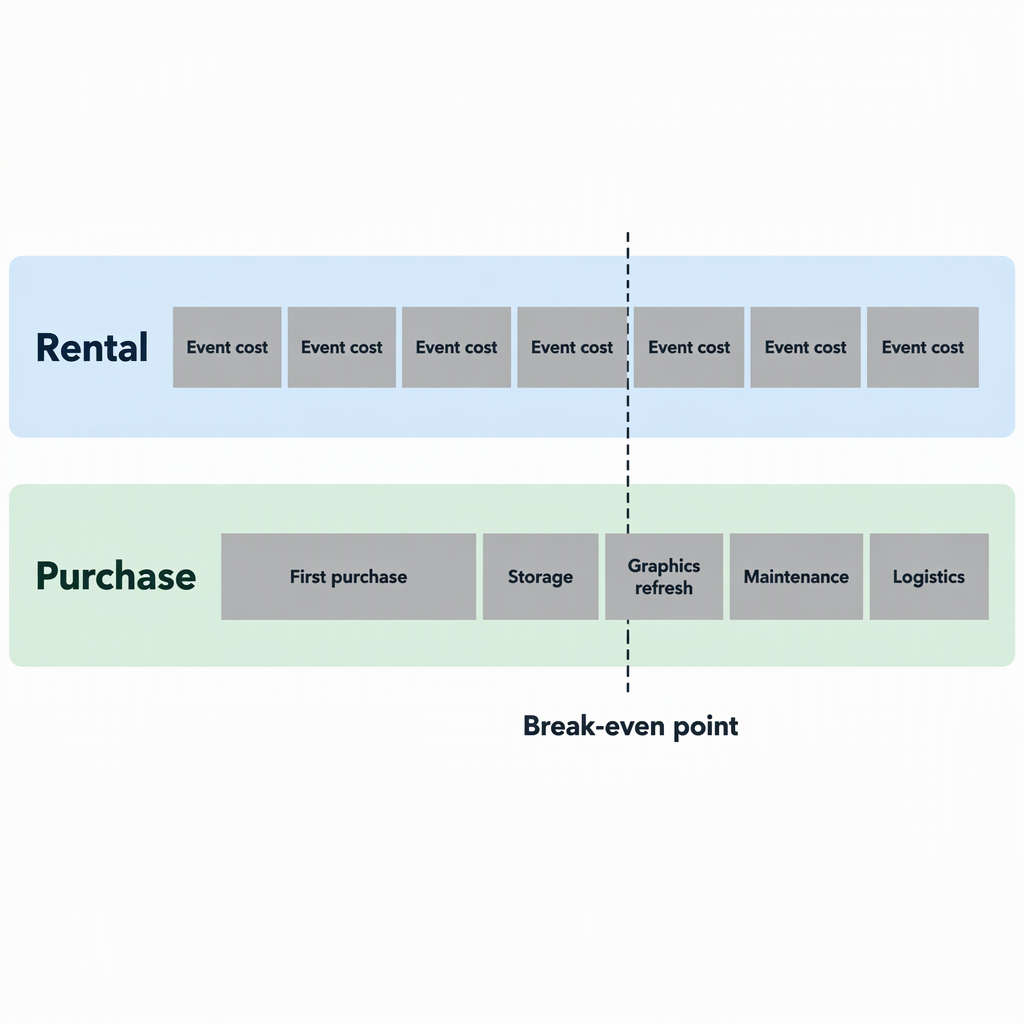
Split the lines: structure, first graphics set, packing cases and configuration work are one-off; transport, installation, venue handling, storage, refresh and spares recur per event.
Match the scope, so each line on both sides covers identical work — the same booth size, configuration, graphics area and installation responsibility.
Total the one-off and per-event lines separately for each option, including refundable security or carnet costs that still tie up cash.
Divide the one-off total by the number of events, then add the per-event total, to get a cost per event for each option.
Repeat at two or three counts — for example one show, four shows and eight shows — and note where the ranking changes.
List what is still unpriced, such as storage space, graphic refresh, venue labour or customs fees, and get those quoted before you commit.
Ownership moves the between-show costs to you: storage, condition checks, cleaning, spares and reprinting graphics when branding changes. They do not appear on the purchase invoice and can still make a low purchase price lose to a hire over a short programme.
Storage: where the crates live between shows, access when you need them, and what the minimum term costs.
Condition checks: inspecting frames, panels and any electrical parts after every dismantle and before each dispatch. Before you inspect, test or replace a lighting or electrical component, isolate the stand's power supply — switch it off and unplug or disconnect it from the venue supply — and handle only de-energised fittings, following the stand manufacturer's manual for that component.
Graphic refresh: reprinting panels when the message, product or branding changes, with artwork kept in a reprintable format.
Spare parts: connectors, feet, lighting and panel fixings that wear fastest in repeated builds. Fit replacement lighting and electrical parts only with the power isolated and the fitting disconnected from the supply, following the manufacturer's instructions for that component.
Cleaning and transport: cleaning panels and cases, plus the return leg of every move.
Insurance and disposal: covering the asset, its transit and its time on site, and the cost of resale or disposal at the end.
The Net Zero Carbon Events pledge commits signatories to publish a net zero pathway, measure Scope 1, 2 and 3 emissions, report progress every two years and check carbon reduction in procurement. Ask signatory suppliers, venues and organisers for published reuse and emissions figures.
Renting suits a short or uncertain calendar and a different look at each show; buying suits a stable specification, a modular stand and enough events to absorb the one-off outlay.
Which option fits which exhibition programme | ||||
Programme | Events | Specification | Logistics | Better starting point |
|---|---|---|---|---|
Single show, no further commitment | One | Bespoke, unlikely to repeat | Supplier delivers and installs | Renting |
Two or three domestic shows | Two to three | Fixed theme, minor graphic updates | Either party can manage | Test the break-even count first |
Regular domestic programme | Four or more | Modular, graphics refreshed not rebuilt | You manage storage and transport | Buying, with a reuse plan |
Multi-country programme | Four or more | Modular, adaptable to different stand sizes | You manage, including documentation | Buying, if documentation is manageable |
Distributor or design firm building a reusable kit | Ongoing | Modular families with replaceable parts and graphics | You manage, or your logistics partner does | Buying in extendable modules |
Multi-market programmes meet different venue rules, labour arrangements and charges at every stop. UFI's network of approved events spans more than 85 countries, so plan documentation, storage and installation country by country.
Get the inclusions, the exclusions, the party responsible for labour and the damage terms in writing before you sign. A quote that leaves storage, venue charges, graphics or installation unpriced is not cheaper; it is unfinished.
A line-by-line list with each item marked included, excluded or to be quoted.
Who supplies installation and dismantling labour, and whether the venue requires its own approved contractors.
Who owns and stores the artwork files, and the basis on which graphics are reprinted.
Transport, unloading, empty-case storage and return legs, with the number of cases stated.
Venue charges billed directly to the exhibitor, including handling, rigging, power and late-working rates.
Storage location, access hours and minimum term if you are buying.
Damage, liability and insurance: who insures what, the excess, and how damage is reported and settled.
What happens if a show is postponed, cancelled or moved, and who carries the cost in each case.
Vetting the supplier is part of comparing the quotes. ESSA, a UK trade body for event suppliers and services, requires its members to sign a Quality Service Charter and Code of Conduct, to provide annually checked proof of £5 million public liability insurance and to pass credit and accounts checks repeated every quarter.
That is a membership requirement, not an independent certification of performance on your show, and it applies to the UK market. Buying elsewhere, ask which equivalent scheme the supplier belongs to and what it checks.
Build the rental column and the purchase column from one shared list of cost lines, price or exclude every item, then convert both to a cost per event and test the result at two or three event counts.
Renting keeps the spend variable and pushes delivery, installation, storage and refresh onto the supplier; buying converts the spend into an asset and leaves those recurring lines with you. Treat the break-even count as an estimate, and re-run it whenever event numbers, stand sizes or destinations change.
These are the points buyers raise most often when a rental quote and a purchase quote are put side by side.
Rewrite both offers against one shared list of cost lines and the same scope: the same booth size, configuration, graphics area and installation responsibility. Then mark every line included, excluded or to be priced, and only compare totals once no line is blank.
Sometimes, and price it locally: residual value depends on the structure type, how replaceable the graphics are and local demand. Modular frames with standard, replaceable connectors are often easier to resell locally, so ask what is stocked as spares.
The contract decides it. Before signing, confirm who supplies the crew, who insures the stand in transit and on site, the excess, and how damage is settled; if you build the stand yourself, confirm your own cover.
There is no universal number; it comes from your own figures. Add one-off purchase costs to the recurring ownership lines per event, then compare with cumulative rental; where the lines cross is your break-even point.
Space for the packed crates, conditions that keep frames and panels serviceable, access for dispatch or inspection, an inventory of each case and a condition check before every dispatch. Storage and access are local costs, so price them where the stand will live.
Not automatically. A carnet suits goods that travel temporarily and return, and eligibility depends on the countries and goods involved, so confirm each route with the national issuing association. On a hire, the supplier normally arranges movement, so check who is the importer and exporter of record and who carries duty, deposit or documentation costs.
Graphics usually age first: panels carry the message while the frame stays sound. Modular systems let you reprint panels and re-skin frames, so ask how artwork files are handed over, how reprints are priced, and whether the frame takes a new panel size.


