
Views: 0 Author: Site Editor Publish Time: 2026-11-21 Origin: Site


A stand material is reusable only when the element built from it is taken down, packed, transported and rebuilt at a later event; the material name alone proves nothing. Evaluate a specification in five passes: define where the stand is reused, compare each material family on the end-of-life route it can actually reach, require written evidence behind every claim, screen the specification details that decide a second build, and name the disposal route before the first build.
A material is reusable when the elements built from it are designed to be used at more than one event instead of being discarded after a single show. The Better Stands programme, an industry collaboration on stand reuse, names aluminium, glass, wood, plastic and steel as possible materials, but attaches the condition that decides everything: those elements have to be reused at a future event. A timber counter that returns to the next show is reusable; an aluminium frame that is scrapped after one build is not.
Better Stands defines a reusable stand as one designed to be used multiple times rather than disposed of after a single use, and rates a stand on a 10-point checklist with four levels: single use, bronze, silver and gold.
The assessment methods behind that rating are worth understanding before you discuss it with a supplier. One method reviews documentation submitted to the programme's platform and is checked by a trained assessor with spot checks; the other observes build-up and breakdown onsite. Both judge design, packing and handling, which is why two quotes with the same material can end at different levels.
Because it is the industry's long-standing norm rather than one project's oversight. UFI, the global association of the exhibition industry, describes single-use stand construction as a long-standing sustainability challenge and gave its 2026 Sustainable Development Award to Better Stands, a practical, tiered system aimed at the problem. That tells you the industry treats single-use builds as systemic; it does not tell you that a supplier on your shortlist has solved it.
Treat industry recognition as context, not certification: an award announcement names a programme and a problem, not an audited factory, frame or production batch.
A bronze, silver or gold level is a rating of a stand's reuse design against a checklist. It says nothing about recycled content, the durability of a joint or the supplier's company, so keep those questions in separate conversations.
Compare them on one field: what the component can become after the last show. Aluminium, glass, wood, plastic and steel are all used in reusable stands, and the programme assesses the stand rather than the material, so the useful questions are which end-of-life route each family can reach and what a supplier can put in writing about it.
Material families compared by role in a reusable stand and the end-of-life route you can verify | |||
Material family | Typical role in a reusable stand | End-of-life route you can check | Ask the supplier |
|---|---|---|---|
Aluminium | Frames, beams, lightbox housings, connectors | Aluminium scrap is one of the streams with EU end-of-waste criteria. The aluminium industry states the metal can be recycled repeatedly without loss of quality. | How coatings, anodising and mixed fixings are separated before scrap goes to a yard. |
Steel | Base plates, sub-frames, counter carcasses | Iron and steel scrap are also covered by EU end-of-waste criteria. | Whether the grade and surface finish are accepted locally. |
Glass | Shelves and decorative or light-diffusing panels | Glass cullet is covered by EU end-of-waste criteria. | Whether laminated, coated or toughened panels are accepted. |
Wood | Panels, counters, floors, totems | Prevention and reuse rank above recycling in the EU waste hierarchy, so holding panels as spares comes first; the route after that depends on the local facility. | Whether painted, laminated or treated panels are accepted, and which panels can be kept as spares. |
Plastic and printed graphics | SEG graphic panels, printed boards, moulded parts | A draft implementing act on plastics end-of-waste criteria was presented for public consultation in December 2025, so a plastics route is not settled at EU level the way metal and glass routes are. | Whether graphics are replaceable on the same frame, and what the print substrate is. |
The International Aluminium Institute states that aluminium can be recycled over and over again without any loss of quality, that almost 75% of the 1.5 billion tonnes ever produced is still in use today, and that more than 30 million tonnes of scrap is recycled globally each year.
Use those figures as context for the material, not as a stand specification; they do not cover coated or composite components, mixed-material assemblies, fixings or the recycled content of a finished stand.
Ask for the record behind the claim rather than the claim itself. A reusability statement should arrive with the assessment it came from, and a materials statement should name the element, the material and how the figure was obtained. If a supplier cannot produce either, treat the statement as marketing copy and price that risk in.
Which elements will be reused at a future event, at which event, and where they are stored between shows.
The stand assessment record: either a pre-event documentation review with spot checks, or an observation of build-up and breakdown onsite.
A design-stage statement of the intended route for each material fraction, since the European Commission states that up to 80% of a product's environmental impacts are determined at the design phase.
The pre-shipment check: whether the agreed configuration is assembled and reviewed before it leaves the factory, and whether you receive that record.
The pre-production sample record: whether a sample of the agreed configuration was assembled, dismantled and packed before full production.
The batch check: how each production batch is matched against the approved sample before shipment.
A spare-part and accessory list covering the parts that wear: connectors, clips, feet, replacement panels and printed graphics.
How any recycled-content figure was obtained, and whether the supplier can substantiate it.
The European Commission's March 2023 proposal for a Directive on substantiating green claims is still a proposal rather than adopted law, so it is a direction of travel, not a test you can enforce in a contract today. What you can enforce is paperwork: name the document you expect in the purchase agreement.
A reusable-stand assessment is not evidence of recycled content, or of an accepted recycling route for a specific component in your market.
Screen the details that decide whether the same elements come back to a second show: whether a second use is planned at all, how joints are made, how large and heavy each element is, how it packs, how graphics are attached, whether spares can be reordered and whether anything is verified before shipment. Material choice matters, but these details usually decide whether a second build happens.
Before you commit the order, ask for a pre-production sample or pilot unit of the agreed configuration, have it assembled, dismantled and packed into its transport case, and check it against the drawing, packing plan and graphics attachment. Keep that record as the benchmark for later batches.
Specification screening: answers that support reuse and answers that block it | ||
Specification detail | Answer that supports reuse | Answer that blocks reuse |
|---|---|---|
Planned second use | A named future event, an owner and a storage location are agreed before the build | No second use is planned, which makes the stand single-use by default |
Pre-shipment verification | The agreed configuration is assembled and reviewed before shipment, and the record is shared with you | No documented pre-shipment check of the configuration |
Joints and connections | Releasable, re-tightenable mechanical joints | Connections that damage elements when they are opened |
Element size and packing | Modules one or two people can lift, each with a labelled place in a reusable case | Oversized panels and loose, mixed hardware |
Graphics | Printed panels that are replaced on the same frame | Graphics bonded to the structure |
Replacement parts | Connectors, clips, feet and printed panels can be reordered as spares | No reorder route for wearing parts |
Plan it while the stand is still a drawing. The European Commission states that up to 80% of a product's environmental impacts are determined at the design phase, so how a stand is taken apart, separated and routed is fixed by the specification rather than by the crew on the last day of a show.
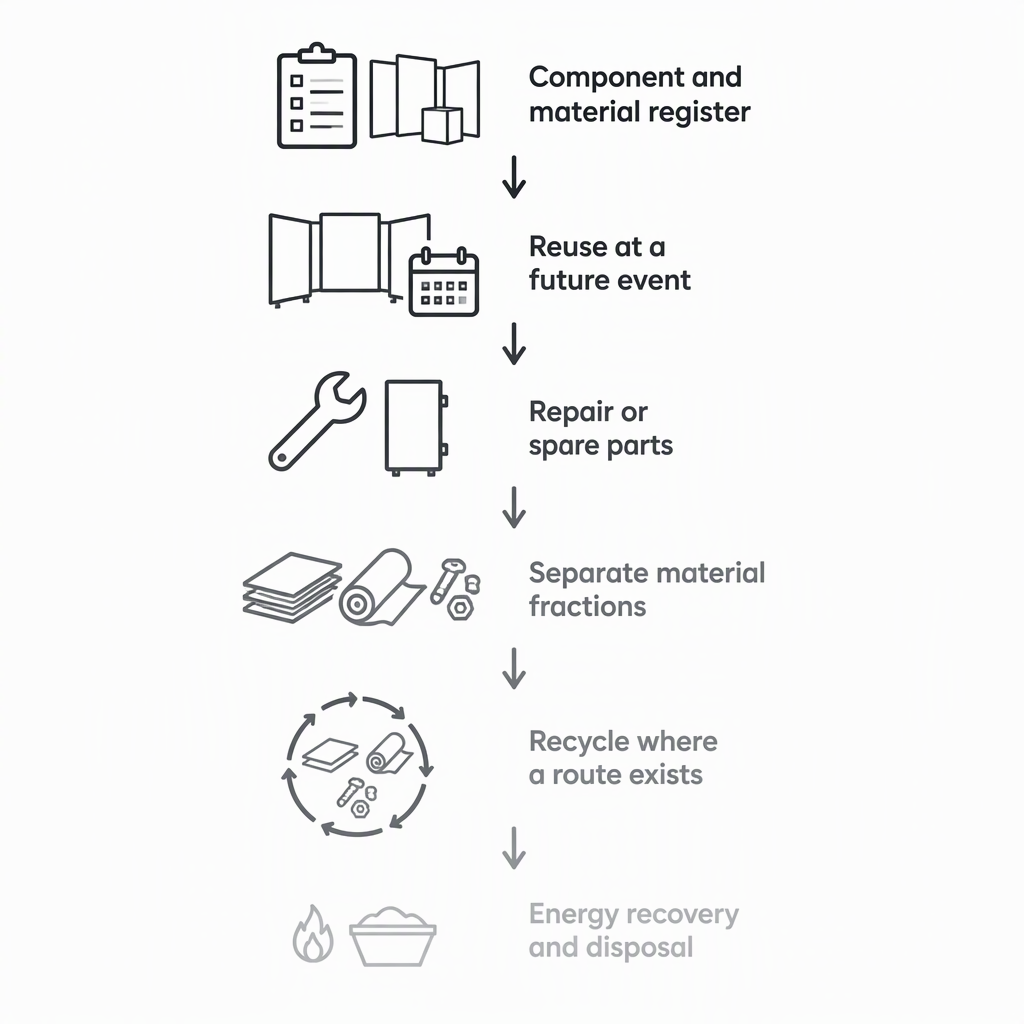
Build a component and material register at specification stage: each element, its material, its fixings and its approximate weight.
Name the reuse event, the owner of each element and the storage location before the first build.
Plan repair and spares. A replaceable panel or connector keeps a frame in service; a graphic bonded to the structure can retire it.
Keep electrically powered parts separate: power supplies, drivers and cabling form their own fraction, and the supply should be isolated by a competent person before any of them is disconnected or removed.
Separate the remaining fractions so each can reach a stream that exists: at EU level, end-of-waste criteria are laid down for iron, steel and aluminium scrap, glass cullet and copper scrap.
Work down the hierarchy rather than up it: prevention and reuse rank above recycling, and energy recovery and disposal are the last resort.
The EU Waste Framework Directive sets the five-step waste hierarchy, the polluter-pays principle and extended producer responsibility. The Commission's page also records which end-of-waste streams exist at EU level and notes that a draft implementing act on plastics end-of-waste criteria went out for public consultation in December 2025, so a plastics route is not settled the way metal and glass routes are.
For scale, the Commission reports that the average European produces around five tonnes of waste a year and that only 41% of waste in the EU is recycled. Those are EU-wide figures across all waste streams, so use them as background rather than as a stand or exhibition-industry number.
Routing is decided nationally and locally. Confirm with the receiving facility and your local authority which separated fractions they accept, and in what condition, before you promise a disposal route to a client.
Run the same five passes on every project: define where the stand is reused, compare material families on the end-of-life route they can reach, verify each claim against a document, screen the specification details that decide the second build, and name the disposal route before the first one. A specification that fails a pass is a single-use build with a longer invoice.
Two ideas carry most of the weight. Reuse is a property of the whole element and of how it is handled, not of a material name, so the questions go to joints, packing, graphics, spares and verification. And the end-of-life route is decided at design stage and then constrained by local rules, so ask the receiving facility early and write the answer into the specification.
Keep the evidence with the decision: the assessment record, the pre-shipment configuration check, the spares list and the material register. Those documents are what turn a sustainability adjective into something a brand procurement team can approve.
These are the questions distributors, design studios and brand procurement teams raise most often once a client asks for a stand that can be used again, and for a disposal route that can be defended afterwards.
Not on its own. The reuse programme treats aluminium, glass, wood, plastic and steel as possible materials and assesses the stand design and its handling instead. What genuinely differs is what happens after the last show: the aluminium industry states the metal can be recycled repeatedly without loss of quality, and aluminium scrap is one of the streams with EU end-of-waste criteria. A wood, plastic or composite element can still be the better choice where it is reused several times and separated locally.
Design intent is not the constraint: the programme states that reusable stand types exist for every budget and aesthetic, so the design conversation is about how the stand is built, not whether it can look right. Treat the frame as the returning asset and change graphics, finishes and furniture per show.
It rates how a stand is designed for reuse against a 10-point checklist, from single use up through bronze, silver and gold. The rating is produced either from documentation reviewed by a trained assessor with spot checks or from an onsite observation of build-up and breakdown. It is not a product certification, it does not cover material composition or recycled content, and it says nothing about the supplier's company. Ask for the assessment record for your specific configuration.
Only from a written declaration that names each element, the material and how the figure was obtained. Marketing adjectives do not establish a percentage, and substantiation rules are tightening: the European Commission submitted a proposal for a Directive on substantiating green claims in March 2023. Request the declaration before you place the order, and check it against the bill of materials rather than the brochure.
No material name answers that. Ask the supplier for the test method, the number of cycles and the loading conditions behind any figure they quote, plus the warranty's treatment of repeated assembly and dismantling. A reusability rating is not a durability test result, so treat a cycle count without a method as unproven.
No. The rating addresses how a stand is designed for reuse, while waste obligations depend on national implementation of EU law and on the route the material actually takes. Confirm with your local authority and the receiving facility what they accept from your site, and keep that answer with the stand documentation.
Work down the waste hierarchy: keep elements in service as spares first, then route separated fractions to a recycling stream where one exists. At EU level, end-of-waste criteria are laid down for iron, steel and aluminium scrap, glass cullet and copper scrap, while plastics criteria were still a draft implementing act put out for consultation in December 2025. Energy recovery and disposal come last.
Name the reuse event and the number of shows the stand must cover, the storage location and owner, the graphics change cycle, and the element sizes your transport and venue access allow. Ask for the pre-shipment check — whether the agreed configuration is assembled and reviewed before it leaves the factory — and for the pre-production sample record that later production batches are matched against. State the end-of-life route you expect as well, because at this stage most of a product's environmental impact is still open to influence.


